Wednesday, April 28, 2010


Cognitive Theory of Depression
 http://www.savagechickens.com/images/chickensuckage.jpg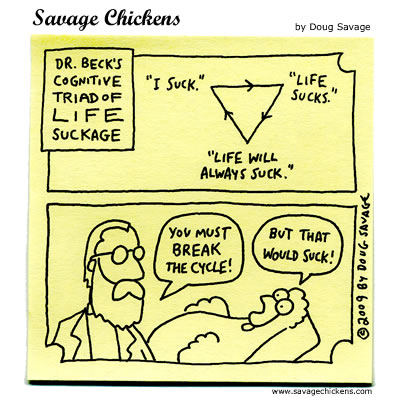
 http://i.pgcdn.com/muze_images/books/7/01/9780471189701_150x150.jpg
The Cognitive Theory of depression states that depression's outcome from faulty, maladaptive or irrational cognitions taking the shape of distorted thoughts and accusations. Depressive cognitions can be understood and applied socially, through observing. For example the case when kids in a dysfunctinal family watch their parents fail to successfully cope with strressful experiences and other difficult, traumatic sucessions. In the other hand, depressive cognitions may also come out from a lack of experiences that would make it easier to the development of adaptation to coping abilities.
Well, according to the cognitive theory of depression, the depressed persons think very differently from those that aer'nt depressed. This difference in thinking and judgement causes these people to become more depressed. For instance, people with depression symptoms tend to look at themselves , their surroundings, environment and their future in a very pessimistic and negative way. As an outcome, people who are depressed are inclined to misunderstand things in pessimistic forms and then they blame themselves for any little or big misfortune they go through. Overall, this negative way of perception and judgement works as a negative bias, therefore making it easier for depressed people to look at events as them being much worse than what they really seem to be for the rest of the people. This also increases the risk that depressed individuals will develop depressive symptoms in result to very stressful and frustrating situations people face.
Thursday, April 8, 2010
Biological Linked to Learned Helplessness
From the biological term, I can come up with an example relating it to Learned Helplesness in an individual. For instance, a patient suffering from cancer gets depressed due to biological aspects. He or she is a victim of this and most of the time suffers from depression because he or she knows about the bad state he/she is in. Then, that makes them take a negative position and negative thoughts. This then leads to depression and this can be linked to learned helplesness because someone with cancer is more likely to develop learned helplesness due to the constant thought of negativisim towards their prosperity and recuperation of such disease. The patient will learn to feel helpless because he or she will have their self esteem and hopes of curing on the floor. Therefore, Learned Helplesness will be acquired and in rare cases there will be patients suffering from cancer who will be positive, have hope and not feel helpless. To conclude, a person under the influence of cancer is more likely to gain learned helplessness. The way learned helplessness works is that it is acquired and gets worse everyday. A patient with cancer will probably be receiving worse news while his or her disease is spreading and damaging the person. When he or she receives those news, everything will be getting more complicated because the person (patient) who is being treated will start developing a mental state in which a negative attitude and negative thoughts will be gained. With repetition or a constant act of this matter, the person suffering from cancer will be intimidated and will normally start suffering not only from cancer but from depression causing learned helplessness. Also, a person with cancer will see how he or she deteriors from the physical aspect of the body making the patient, yet again, acquire learned helplessness.
Subscribe to:
Comments (Atom)